Mirco Werner,
Johannes Hanika and
Carsten Dachsbacher
Computer Graphics Forum Vol. 45, Num. 4 (Proceedings of Eurographics Symposium on Rendering 2026)
Abstract
Path tracing uses Monte Carlo integration to solve the rendering equation by evaluating the integrand at random sampling points.
The convergence rate of the error can be significantly improved by using correlated instead of random sampling, especially on smooth integrands. However, on integrands with discontinuities due to, e.g., occlusion, the improvement is less pronounced.
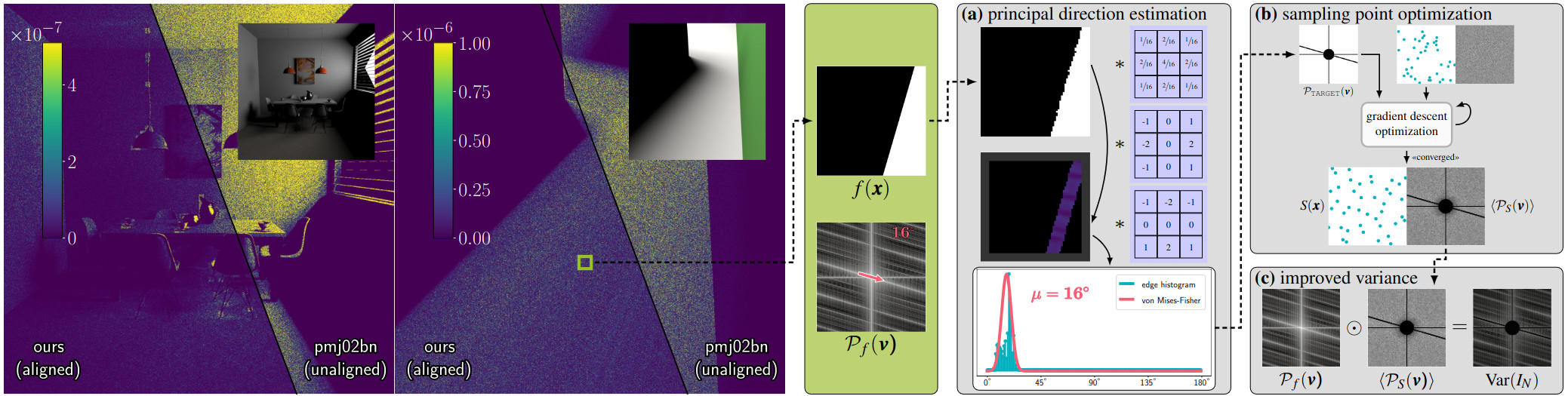
Prior work has shown that the variance of the estimator is equal to the product of the power spectrum of the integrand and the expected power spectrum of the sampling pattern.
Discontinuous integrands have anisotropic power spectra that exhibit high energies along the directions of the discontinuities, which need to match the low-energy directions of the sampling pattern to reduce variance.
However, existing anisotropic sampling patterns have at most two low-energy directions.
Therefore, we propose an optimization-based algorithm to synthesize two-dimensional correlated sampling patterns with spectra that have more than two low-energy directions, leading to improved convergence behavior.
Further, we propose a practical and sample-efficient algorithm that estimates the directions of discontinuities in the power spectra of two-dimensional integrands.
We show that our algorithm can reliably estimate these directions, allowing us to align the low-energy directions of anisotropic correlated sampling patterns with the predicted directions.
We demonstrate in an offline path tracer with light source sampling that our aligned sampling patterns improve the convergence rate on two-dimensional integrands with multiple discontinuities compared to existing anisotropic sampling patterns and thus reduce the error more quickly.
Downloads
Bibtex
@article{2026_anisotropic_sampling,
author = {Werner, Mirco and Hanika, Johannes and Dachsbacher, Carsten},
title = {{Optimized and Aligned Anisotropic Monte Carlo Sampling Patterns}},
journal = {Computer Graphics Forum},
volume = 45,
number = 4,
year = 2026,
publisher = {The Eurographics Association and John Wiley & Sons Ltd.},
doi = {10.1111/cgf.70534}
}